Small tiles.
Big possibilities.
Estimate Tile and Grout Materials and Costs
Calculate tile boxes, grout and thinset mortar for walls or floors. Combine multiple areas, set joint width and product coverage, and download a material-cost PDF.
Measure
Enter the dimensions of your project.
Use one surface and exposure setting for all areas in this estimate. For different conditions or products, make separate estimates.
Choose tile
Choose the materials for your project.
For sheet options, the size is each chip—not the full sheet. Enter the total square feet per box below.
Optional grout estimate settings
We use a 3/8-inch tile-thickness allowance for grout. You can leave this as-is, or enter your tile's thickness for a closer estimate. This assumes full-depth joints; actual grout coverage varies.
Plan purchase
Set your preferences for purchasing.
Mortar estimate settings
Bagged thinset mortar in 50-lb bags. Premixed adhesive requires a separate estimate.
Estimate assumptions & exclusions
Reference material prices only; verify product coverage and current supplier prices before buying. Labor, tax and delivery are excluded.
Tile Materials Estimate
Tools & Accessories Commonly Needed
Check what you already own before shopping. These tools and accessories are additional to the material total above.
Common tools
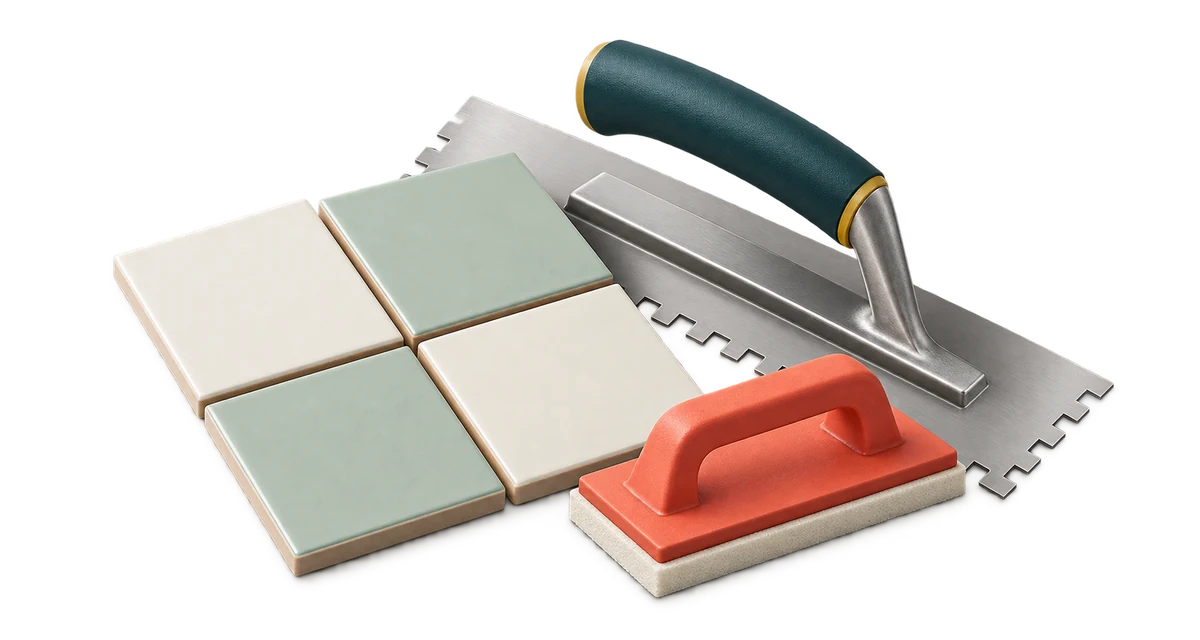
- Tape measure, tile marker, level and straightedge
- Notched trowel matched to the selected mortar and tile; margin trowel
- Mixing bucket and mixing tool approved for the product
- Tile cutter or suitable wet saw; nippers or a tile hole saw for detailed cuts
- Grout float, grout sponge and clean-water buckets
Accessories to check
- Tile spacers for the selected joint width
- Leveling clips and wedges if appropriate for the tile and system
- Wall-tile supports or a ledger, where suitable for the installation
- Edge profiles and compatible flexible sealant for movement joints
- Gloves, eye protection and other protection specified by the product or tool instructions
- Knee pads for floor work; surface protection and cleanup supplies
Consider renting a wet saw for a one-time project. Backer board, waterproofing and substrate preparation depend on the assembly and are also priced separately.
Planning your project
How to calculate tile, grout and mortar needs
Add the net square footage of every area using the same tile and product specifications. Estimate tile, grout and mortar separately: tile cutting waste is different from grout or mortar application reserve.
Tile coverage, pieces and boxes
- Net area: add each area’s length in feet × width in feet, then subtract its cutouts.
- Order target: net area in sq ft × (1 + waste percentage ÷ 100). A 10% allowance uses a multiplier of 1.10.
- Approximate individual tile count: round up the order target in sq ft ÷ ((tile width in inches × tile length in inches) ÷ 144).
- Boxes to buy: round up the order target in sq ft ÷ the square feet covered by one box.
The calculator offers 10%, 15% and 20% extra tile. Choose an allowance for the actual layout, cuts and spare pieces; a pattern does not have one universal waste rate. For mounted mosaics, individual chip dimensions drive grout use, while the box’s stated coverage drives purchasing. Approximate tile counts are not a layout or carton piece count.
Grout weight and package size
Grout use depends on tile/chip size, joint width, filled joint depth and the selected grout. Where available, this calculator uses Polyblend Plus manufacturer coverage tables and scales for the entered depth. Other size combinations use an approximate model calibrated to those tables.
Grout needed (lb) = net area (sq ft) ÷ published coverage (sq ft per package) × package weight (lb) × 1.10
Use coverage for the matching tile, joint and depth. For 12″ × 12″ × ⅜″ tile with ⅛″ joints, the reference is 348 sq ft per 25-lb bag of sanded grout. This example needs 100 sq ft ÷ 348 sq ft per bag × 25 lb per bag × 1.10 = 7.90 lb. The calculator prices 7-lb packs, so it budgets two packs. Product compatibility and actual coverage should be confirmed before buying.
Wall or floor, dry or wet
Wall/floor and dry/wet settings provide application guidance. The same bag formula applies to both orientations. Mortar product, trowel and application conditions determine coverage; changing surface or exposure alone does not apply a quantity multiplier. Wet-area contact coverage is not an extra-material percentage.
Thinset mortar bags
Mortar bags = round up (net area in sq ft × 1.10 ÷ coverage in sq ft per 50-lb bag)
Open Mortar estimate settings to enter the published square feet per 50-lb bag for your chosen product and trowel. Suggested mode keeps the tile-size-based allowance. The estimate includes 10% application reserve, and bag quantities always round up. Bagged thinset is estimated; premixed adhesive needs separate product-specific coverage.
For this 12″ tile example, the calculator uses 60 sq ft per 50-lb bag with a ¼″ × ⅜″ × ¼″ square-notch trowel, the lower end of the published VersaBond coverage range. The trowel and mortar must suit the tile and substrate. Back-buttering or uneven surfaces can increase use.
Worked example: 100 sq ft of 12″ × 12″ tile
Inputs: 10 ft × 10 ft, no cutouts, 10% tile waste, ⅜″ tile thickness, ⅛″ grout joints, 15 sq ft per box and tile priced at $3.80/sq ft.
| Material or measure | Calculated need | Purchase allowance |
|---|---|---|
| Tile | 110 sq ft order target; approximately 110 tiles | 8 boxes covering 120 sq ft · $456.00 |
| Sanded grout | 7.90 lb including 10% reserve | 2 × 7-lb packs · $36.00 |
| Thinset mortar | 110 sq ft application allowance | 2 × 50-lb bags · $44.00 |
| Estimated materials | Reference prices for this example | $536.00 |
Tile coverage includes cutting waste; grout and mortar use the installed area plus their own 10% application reserve. Backer board, waterproofing, substrate repair, trim, movement-joint sealant and tools require separate allowances.
Coverage sources: CUSTOM Polyblend Plus sanded grout coverage and CUSTOM VersaBond mortar coverage.
Worked examples use fixed inputs and reference material allowances checked October 29, 2026. Your estimate changes with the inputs and product details. Labor, tax and delivery are excluded.
Tile project questions
How many boxes of tile do I need for several walls or floors?
Add each rectangular area and its cutouts. The calculator combines net square feet, adds your tile waste allowance and rounds up using the square feet covered by one box. Use a separate estimate for different tile products or installation conditions.
Does a shower wall need a different mortar calculation?
The bag formula is the same, but the mortar and assembly must suit the tile, wall and wet conditions. Choose Wall and Wet area for guidance, then enter the published square feet per 50-lb bag for your product and trowel. Waterproofing is a separate allowance.
Does grout joint width change how much grout I buy?
Yes. Tile/chip dimensions, joint width and filled depth affect grout use. The calculator estimates pounds, then rounds up to the stated grout package size. Mounted-mosaic grout uses chip dimensions, while tile purchases use box coverage.